Channel ModelVer. 1.0Open Access24 / 60 GHzYokohama, Japan
CPSQDSIM – Site-Specific Channel Model Simulator
A MATLAB-based site-specific quasi-deterministic (QD) channel model simulator
for millimeter-wave systems. Generates spatially-consistent multipath channel data
(PathGridData) by combining ray tracing with site-specific statistical parameters.
CPSQDSIM is distributed as a standalone Windows application. The application and the
site-data package are distributed separately – download both, then follow the
installation steps in the manual.
Windows Installer
Standalone desktop GUI (Ver. 1.0) for generating channel data, exploring maps and
multipath components, and exporting CSV files. Requires the matching MATLAB Runtime.
User input files – the matching map and ray-tracing dataset for the study areas,
supplied per frequency, with the LSP/SSP parameter table.
Published on Zenodo under CC BY 4.0.
Full manual: technical background, installation, the WI Exporter workflow, every GUI
control, the CSV export formats and the model verification results. The key steps are
also in the quick start.
CPSQDSIM is a MATLAB-based site-specific quasi-deterministic (QD) channel model simulator
developed by the Radio Signal Processing Laboratory at Niigata University.
It generates grid-wise multipath component (MPC) datasets — called
PathGridData — that describe the propagation channel at each
grid point in a target area, enabling spatially-consistent channel simulation
for millimeter-wave mobile systems.
The simulator combines deterministic information from ray tracing with
site-specific statistical parameters (LSPs and SSPs) measured from
field campaigns in Yokohama, enabling accurate reproduction of real-world
propagation for 5G/6G mmWave system evaluation.
Simulator Inputs & Outputs
Frequency
24 GHz and 60 GHz
Input (Required)
Ray tracing cluster data (WirelessInSite .p2m/.city) and the SSP parameter table (.csv)
Input (Optional)
User-defined LSP/PL parameters (.csv)
Statistical Parameters
Site-specific LSPs and SSPs (Yokohama)
Output
PathGridData: path gain, delay, AoD, AoA per grid point (.csv)
Recipe parameter calibration for unrecognized objects
Spatial consistency for non-stationary UE
Selectable SSP/LSP: 3GPP standard or site-specific measured
System Framework
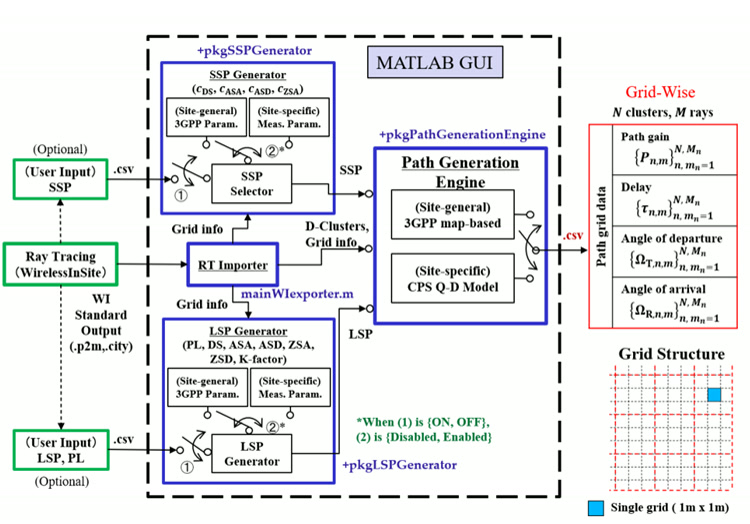
CPSQDSIM framework: Ray tracing output and optional user SSP/LSP are fed into
the SSP Generator, LSP Generator, and Path Generation Engine to produce
grid-wise PathGridData. The Path Generation Engine supports both site-general
3GPP map-based and site-specific CPS QD models.
MATLAB GUI
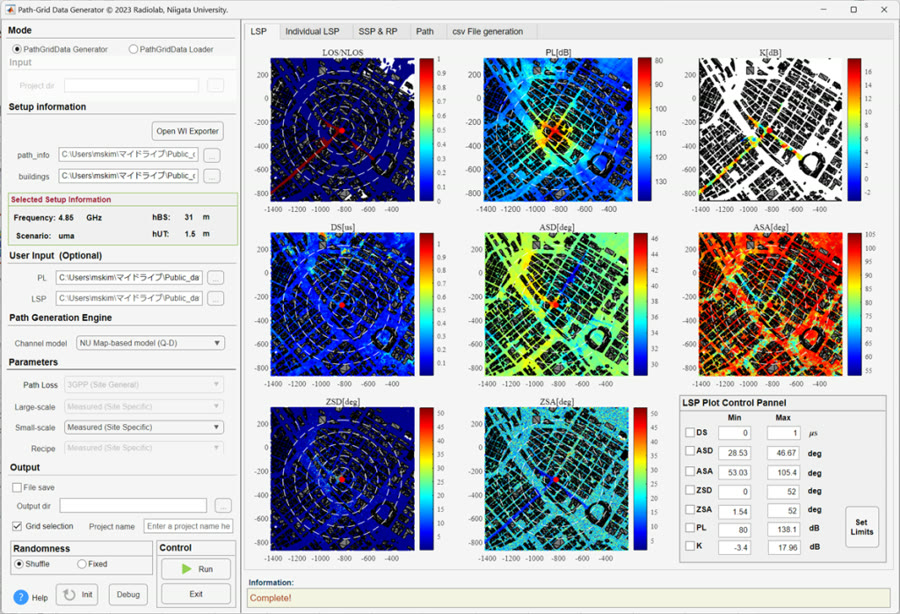
Heat map of simulated channel parameters overlaid on street map, with LSP CDF plots and parameter tables.
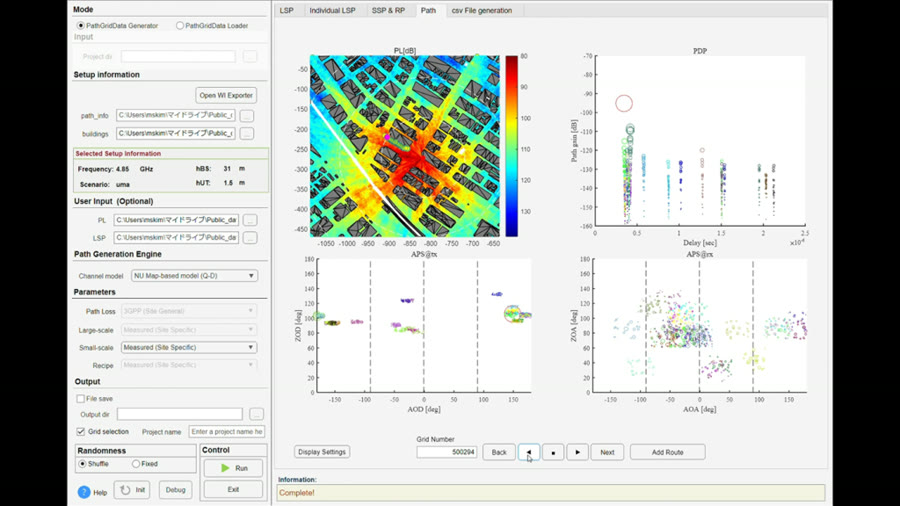
Path generation view showing delay-angle power spectrum (PDP, APS) for individual grid points.
Site-Specific Statistical Channel Parameters
CPSQDSIM uses site-specific LSPs and SSPs measured from field campaigns in
Yokohama City, Japan. Parameters are available for both mm-Wave and Sub-6GHz bands.
If you use CPSQDSIM or the site-specific statistical parameters in your research,
please cite the following papers:
@dataset{kim2026cpsqdsim,
  author    = {Kim, Minseok and Calist, Inocent},
  title     = {{CPSQDSIM: Site-Specific Channel Model
               Simulator}},
  year      = {2026},
  version   = {1.0},
  publisher = {Zenodo},
  doi       = {10.5281/zenodo.22644137}
}

@article{tsukada2025millimeter,
  author  = {Tsukada, Hibiki and Suzuki, Naoya and
             Bag, Banibrata and Takahashi, Riku and
             Kim, Minseok},
  title   = {{Millimeter-Wave Urban Cellular Channel
             Characterization and Recipe for
             High-Precision Site-Specific Channel
             Simulation}},
  journal = {IEEE Transactions on Vehicular Technology},
  volume  = {74},
  number  = {3},
  pages   = {3598--3612},
  year    = {2025},
  doi     = {10.1109/TVT.2024.3492719}
}

@article{takada2024cyber,
  author  = {Takada, Jun-ichi and Keerativoranan,
             Nopphon and {Tran Huu}, Binh Minh and
             Nagao, Tatsuya and Hayashi, Takahiro and
             Kim, Minseok and Kishiki, Yukiko and
             Horihata, Kenshi and {Siy Ching}, Gilbert
             and Sugiyama, Kento and Saito, Kentaro and
             Imai, Tetsuro and Hirose, Miyuki and
             Haniz, Azril and Sawada, Hirokazu and
             Matsumura, Takeshi},
  title   = {{Cyber-Physical Wireless Channel
             Emulation}},
  journal = {IEICE Transactions on Communications},
  volume  = {J107-B},
  number  = {11},
  pages   = {531--549},
  year    = {2024},
  note    = {In Japanese}
}
Related Publications
IEEE TVT 2025
H. Tsukada, N. Suzuki, B. Bag, R. Takahashi, M. Kim,
"Millimeter-Wave Urban Cellular Channel Characterization and Recipe for High-Precision Site-Specific Channel Simulation,"
IEEE Trans. Veh. Technol., vol. 74, no. 3, pp. 3598–3612, Mar. 2025.
DOI Link
IEICE Trans. 2024
J. Takada, N. Keerativoranan, B. M. Tran Huu, T. Nagao, T. Hayashi, M. Kim, Y. Kishiki, K. Horihata, G. S. Ching, K. Sugiyama, K. Saito, T. Imai, M. Hirose, A. Haniz, H. Sawada, T. Matsumura,
"Cyber-Physical Wireless Channel Emulation,"
IEICE Trans. Commun., vol. J107-B, no. 11, pp. 531–549, Nov. 2024. (in Japanese)
License & Terms of Use
CPSQDSIM and the associated statistical parameters are released for
academic and research purposes.
Free to use for academic and non-commercial research
Redistribution requires attribution to the original source
Commercial use requires prior written permission
Please cite the relevant papers when using in publications