Dataset v1.0 Open Access 154 / 300 GHz Indoor & Outdoor

Sub-THz Channel Sounding Dataset

154/300 GHz dual-band channel measurements in indoor and outdoor environments, collected with a Keysight AWG/DGT-based channel sounder at Niigata University, Japan.

154/300 GHz
Frequencies
4
Scenarios
Indoor & Outdoor
Environments
Direction Scan
Measurement Type
LoS / NLoS
Propagation Labels
.xlsx / .mat
Data Format

Dataset Overview

This dataset contains dual-band Sub-THz channel measurements at 154 GHz and 300 GHz, collected by the Radio Signal Processing Laboratory at Niigata University using a Keysight AWG/DGT-based channel sounder. The measurements cover four representative propagation environments: an open square outdoor hotspot, an indoor corridor, an indoor conference room, and an outdoor street canyon.

For each scenario, channel transfer functions (CTFs) are measured by mechanically scanning TX and/or RX horn antennas over the azimuth plane, enabling extraction of multipath components (MPCs) including delay, direction-of-departure (DoD), direction-of-arrival (DoA), and received power.

Measurement Setup

Frequency154 GHz and 300 GHz (dual-band)
Measurement TypeDirectional scan channel measurement
TX/RX AntennaHorn antenna (26 dBi, 9° HPBW)
Signal Bandwidth4 GHz (154 GHz) / 8 GHz (300 GHz)
Delay Resolution250 ps (154 GHz) / 125 ps (300 GHz)
EnvironmentsIndoor (conference room, corridor), Outdoor (street canyon, open square)
LocationJapan
Channel SounderKeysight AWG/DGT Channel Sounder

Measurement Scenarios

Conference Room Indoor
154/300 GHz · Meeting room scenario
Corridor Indoor
154/300 GHz · Access, D2D, and backhaul links
Street Canyon Outdoor
154/300 GHz · Urban street canyon access
Open Square Outdoor
300 GHz · Hotspot access scenario

Measurement Method

Channel measurements were performed using a custom-built dual-band Sub-THz channel sounder based on a Keysight AWG/DGT platform, covering 154 GHz (4 GHz BW) and 300 GHz (8 GHz BW) simultaneously. High-gain horn antennas are mechanically rotated in azimuth at both TX and RX sides to obtain double-directional channel data.

Channel Sounder Specifications
Parameter154 GHz300 GHz
Carrier Frequency154 GHz300 GHz
Signal Bandwidth4 GHz8 GHz
Sounding Signal640 tones1,280 tones
Delay Resolution250 ps125 ps
Delay Span160 ns
Antenna Gain26 dBi
HPBW9°
EIRP14 dBm
Dynamic Range60–80 dB
Back-to-Back Calibration

A back-to-back (B2B) calibration is performed by directly connecting the TX and RX chains to measure the combined system frequency response. This response is divided out of all measured CTFs to yield calibrated channel transfer functions free of hardware distortion.

Dual-band Setup
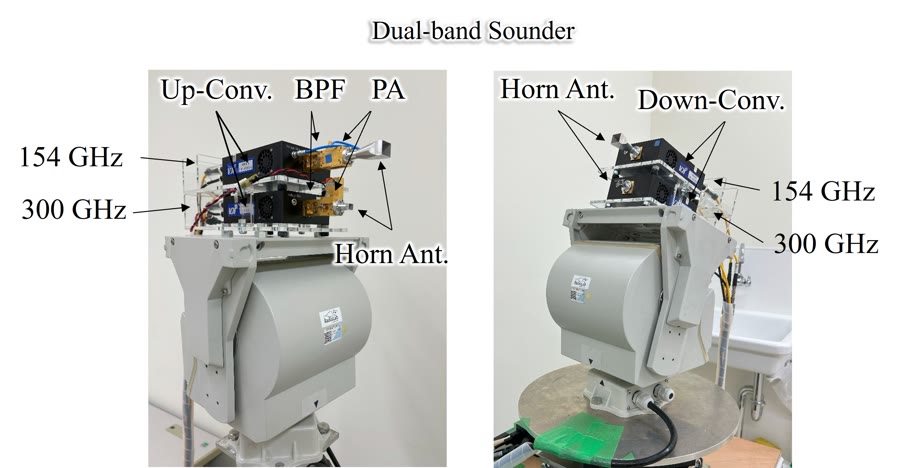
154/300 GHz dual-band channel sounder RF head

TX unit (left) with Up-Conv., BPF, PA, and Horn Ant. for 154/300 GHz. RX unit (right) with Horn Ant. and Down-Conv. Mounted on motorized rotator for azimuth scanning.

System Architecture
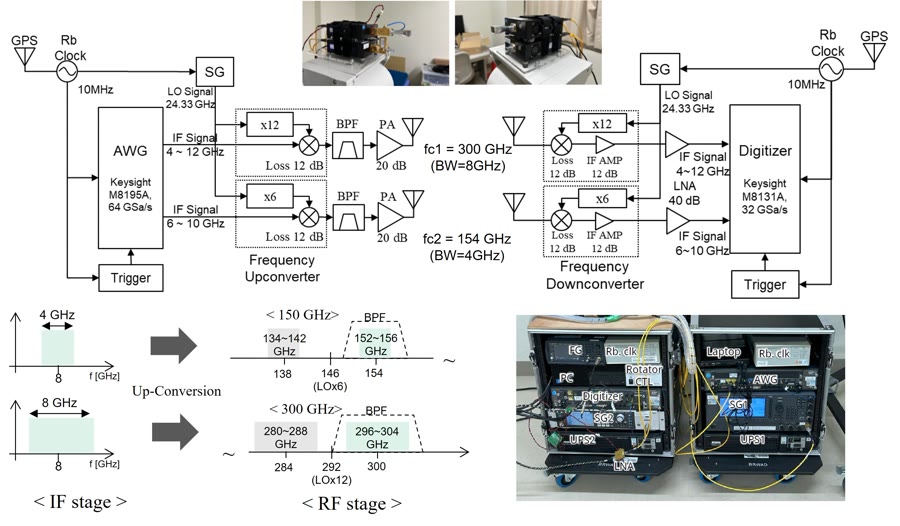
Keysight AWG/DGT Sub-THz channel sounder system block diagram

Full system block diagram with hardware photo. TX: AWG (M8195A, 64 GSa/s) with ×12/×6 upconversion to 300/154 GHz. RX: Digitizer (M8131A, 32 GSa/s) with LNA and downconverter. GPS/Rubidium clock for synchronization.
Datasets

Scenario Environment Frequency Link Type Propagation Reference Data Download
Conference Room
Indoor
Indoor meeting room 154 GHz300 GHz Access LoS / NLoS AWPL 2026
ResearchGate
Available
PL / LSP (.xlsx)
Corridor
Indoor
Indoor corridor 154 GHz300 GHz Access, D2D, Backhaul LoS / NLoS TAP 2025(initial 300 GHz results)ResearchGate Available
PL / LSP (.xlsx)
Street Canyon
Outdoor
Outdoor urban street 154 GHz300 GHz Access LoS / NLoS TAP 2026
arXiv
Available
PL / LSP (.xlsx)
Open Square
Outdoor
Outdoor hotspot access 300 GHz Access LoS / NLoS WCL 2024
ResearchGate
Coming soon

Multi-dimensional CIR-level data and multipath component (MPC) data are available upon consultation. Please contact us for details.

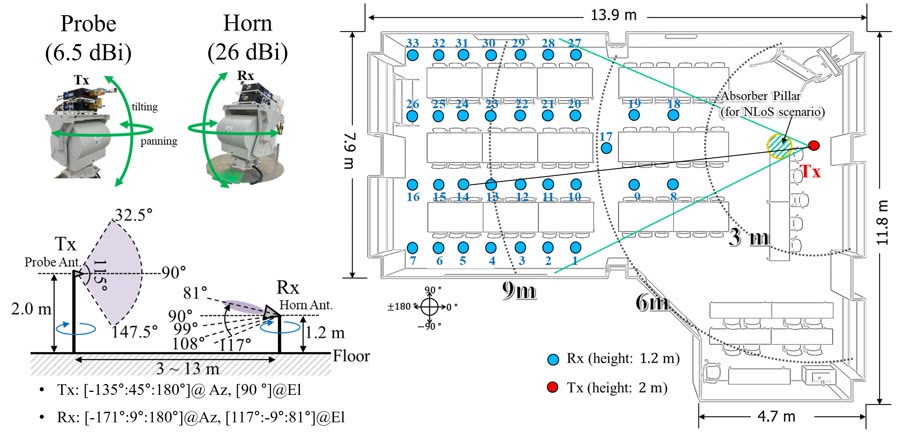
Conference room – floor plan with Tx/Rx positions and antenna setup
Conference Room – 154/300 GHz
Frequency154 GHz and 300 GHz
Link TypeAccess (BS→MS)
PropagationLoS / NLoS
Reference IEEE AWPL 2026
ResearchGate
PL / LSP Data SubTHz_ConferenceRoom_PL_LSP.xlsx

Indoor conference room scenario at both 154 GHz and 300 GHz, characterizing dual-band channel behavior in a typical meeting room.

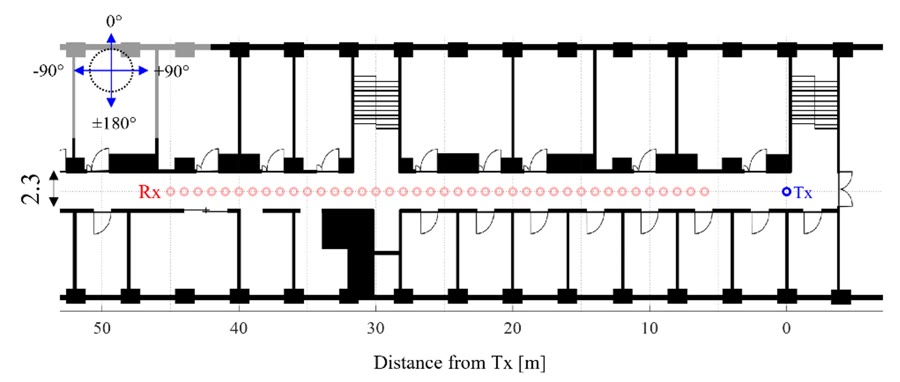
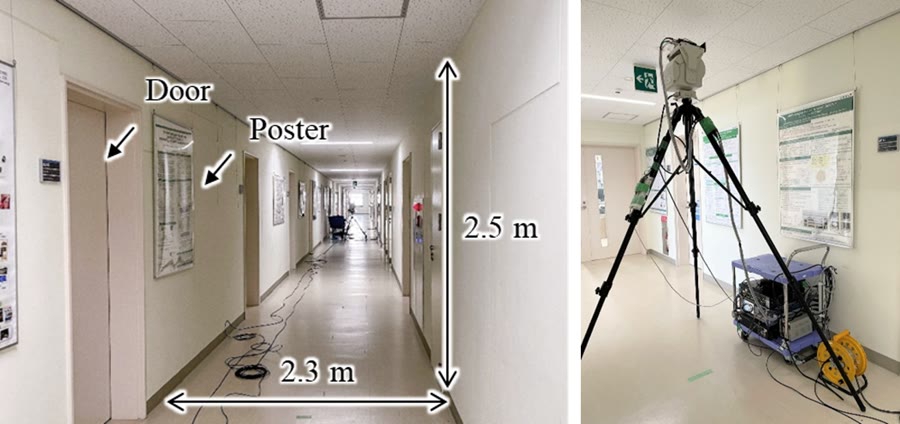
Corridor environment – photo and sounder setup Corridor floor plan with Tx/Rx positions
Corridor – 154/300 GHz
Frequency154 GHz and 300 GHz
Link TypesAccess, D2D, Backhaul
PropagationLoS / NLoS
Reference IEEE TAP 2025
ResearchGate
PL / LSP Data SubTHz_Corridor_PL_LSP.xlsx

Indoor corridor environment at 154 GHz and 300 GHz covering three link types: access (BS-to-UE), device-to-device (D2D), and backhaul (BS-to-BS). The dataset is based on dual-band measurements; the referenced IEEE TAP paper reports initial experimental results at 300 GHz and is provided for reference.

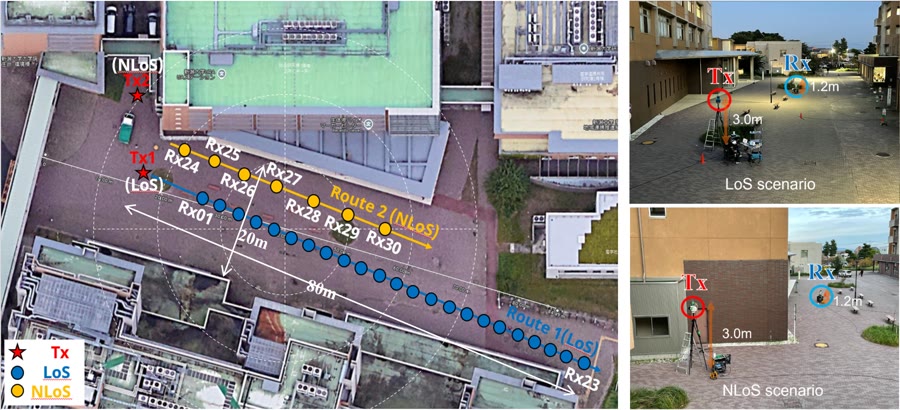
Street canyon measurement setup – aerial map and LoS/NLoS photos
Street Canyon – 154/300 GHz
Frequency154 GHz and 300 GHz
Link TypeAccess (BS→MS)
PropagationLoS / NLoS
Reference IEEE TAP 2026
arXiv
PL / LSP Data SubTHz_StreetCanyon_PL_LSP.xlsx

Outdoor urban street canyon at 154 GHz and 300 GHz for access channel characterization. Quasi-deterministic channel modeling based on measurement data.

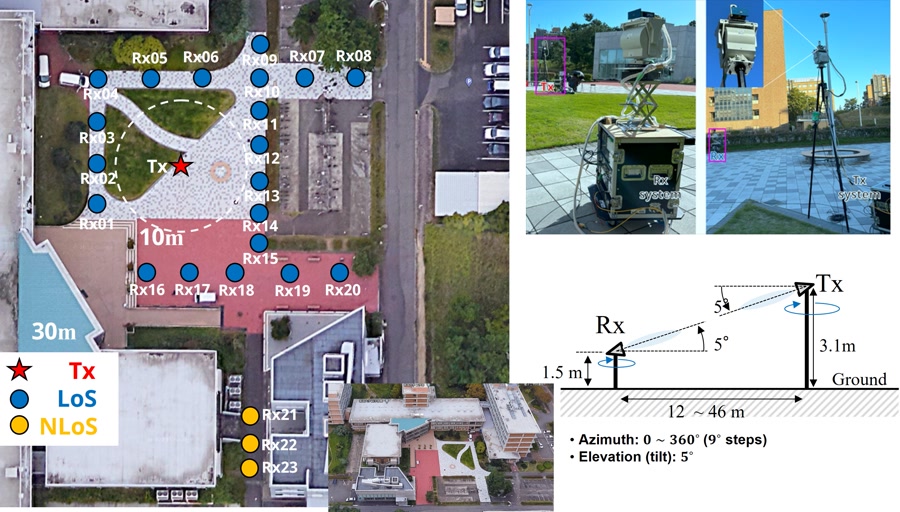
Open Square – aerial map with Tx/Rx positions
Open Square – 300 GHz Hotspot
Frequency300 GHz
Link TypeAccess (BS→MS)
PropagationLoS / NLoS
Reference IEEE WCL 2024
ResearchGate

Outdoor open square hotspot access scenario at 300 GHz. MIMO channel capacity measurements with mechanically rotated horn antennas.

Related Publications & Citation

If you use this dataset in your research, please cite the relevant papers. Click BibTeX to show the citation entry.

License & Terms of Use

This dataset is released under the Creative Commons Attribution 4.0 International (CC BY 4.0) license.

  • Free to use for academic and non-commercial research
  • Redistribution requires attribution to the original source
  • Commercial use requires prior written permission
  • The dataset is provided "as is" without warranty of any kind

Contact

For questions regarding the dataset or collaboration inquiries, please contact:

Prof. Minseok Kim
Radio Signal Processing Laboratory
Graduate School of Science and Technology
Niigata University, Japan